This oral history interview is a project of the Historical Committee of the Outrigger Canoe Club. The legal rights of this material remain with the Outrigger Canoe Club. Anyone wishing to reproduce it or quote at length from it should contact the Historical Committee of the Outrigger Canoe Club. The reader should be aware that an oral history document portrays information as recalled by the interviewee. Because of the spontaneous nature of this kind of document, it may contain statements and impressions that are not factual. A full transcript of the video may be found below.
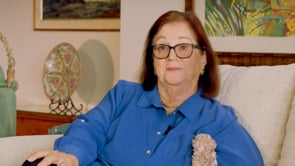
Interview of Pokey Richardson by Glenna Wong
April 21, 2026
GW: Aloha! Today is Tuesday, April 21st, 2026, and we’re breaking tradition because of the ongoing construction at the Outrigger Canoe Club. We’re conducting today’s interview with longtime member Pokey Richardson at her beautiful home at Maunalani Heights on the island of Oahu. I’m Glenna Wong, and I’m a member of the Outrigger Canoe Club’s Historical Committee. One of the Historical Committee’s tasks are to interview longtime members so that we can preserve their history.
Good morning, Pokey.
PR: Good morning, Glenna.
GW: Could you please tell us a little bit about yourself and your family? And if you have any siblings, and when and where you were born?
PR: Certainly, when I was born in Long Island, New York, 1950. July 11th, 1950. 7-11, good numbers. I was the youngest of three in my family, and we moved to California – my dad was transferred, he was in banking and was transferred to San Francisco when I was four to Northern California, where I grew up. My older brother was five years older than I, my sister is seven years older than I, and they were not swimmers, but my brother was an athlete, and my sister was an artist.
GW: Who ordained you with the name Pokey?
PR: My dad, we think, hit me with that name before I was even one, and it just stuck. I was christened Lillian Deborah after my maternal grandmother, and never really used it until after actually 9-1-1 happened. And then I needed to go back and make sure that my Social Security number was under Lillian, rather than Pokey. My driver’s license always said Lillian, but everything else was Pokey.
GW: So you said you moved to Northern California, where did you grow up and where did you go to school?
PR: I grew up in Portola Valley, California, and then, in high school, ended up moving to Santa Clara, which I had been training in Santa Clara from the time I was ten until I was 18, and I went to Santa Clara High School, and then I went to UCLA for undergraduate.
GW: You say training. What was that?
PR: I was a competitive swimmer.
GW: From what age?
PR: I started when I was nine, in competitive swimming and went to my first Olympic Games when I was 14 and my second Olympic Games when I was 18.
GW: Were your parents active in sports?
PR: My dad played football, and my mom was not active, you know in those years, if you remember, I grew up, I was born in 1950. So, I was a teenager in the 1960s. And there were no formal scholastic programs for female athletes. So, there was no competitive program in high school or in college for females to compete in any sport.
PR: There were a few, a few athletic endeavors that a girl could pursue. One was gymnastics. Obviously at five nine I was not gymnastics material, but the other was swimming and then track and field, and I found swimming, and I was very fortunate that I was able to train at Santa Clara Swim Club, which was the strongest swimming program in the world at that time.
GW: Pokey, you mentioned that you found swimming. How can you elaborate on that? What do you mean?
PR: Sure. In northern California, they had a lot of swim and racket clubs, similar to what the Oahu Club is here in Honolulu, where you have a swimming pool and tennis courts, and they have a little summer swimming program. And I competed in that when I was nine. And one of my friends swam in a year-round swim program, and they needed somebody else to make up the relay.
PR: So I joined that program year-round. And then I, I guess I had talent and I had early success age group wise and moved to Santa Clara swim club when I was 11. And that was, nationally and internationally ranked program. And that’s where I really started training to make the national team.
GW: What was your regimen like in swimming? I guess you felt that you were a natural that came easy to you and you enjoyed it?
PR: I did, I really loved it. And, as I said, I, I had early success with it, but I was pretty obsessed and crazy with it. I really loved it and was willing to work really hard at it. And the coach that I swam with, John Williams when I was ten, went to my parents that summer after I had broken several national records and really suggested that I had the ability, if I pursued it, to go to the Olympic Games, and that it would be best if I trained at Santa Clara Swim Club.
And so I can remember my parents and John sitting in in my living room, similar to what we’re doing right now, and bringing me in and saying, you know, Coach Johnny thinks that you could make the Olympic team someday. I’m ten at this point, you know, but it would mean that you would have to move to Santa Clara to train.
And is that something that you’d like to do? And I said, yes, I’d like to do that. And so it was a big commitment on my parents’ part. It was a 45-minute drive each way. And I trained, before school and after school at Santa Clara. So my regiment for training was four days a week
I would get up at 5 a.m., my dad would. My mom would make breakfast and put it in a wide mouth thermos for after practice. And maybe I’d have breakfast on my way to school. And I trained from 6:00 until 7:30 in the morning at Santa Clara. Then my dad would drive me back and drop me off at school.
I didn’t have to go to P.E. at in those days, because they thought I was getting enough exercise so I could leave school an hour early, and my mom would pick me up at 2:00, drive me down to Santa Clara. I would swim from 3:30 to 5:30 in the afternoon, and then we would drive home.
My mom sort of ended up like doing all that. She was an at-home mom, fortunately, and she did all her grocery shopping and errands, and everything in Santa Clara while she was waiting for me to finish training. And so that was four days a week. I swam early in the morning and five afternoons, and then three hours on Saturdays.
GW: How do you think the swimming experience in your younger years – how did it develop and define who you are?
PR: Interesting question. Well, my entire identity as a young person is wrapped around being a swimmer, very definitely. And I thought that, people who weren’t doing something like what I was doing were missing out. I never felt like I was sacrificing or working so hard at something that I was missing something else. People would sort of say, sometimes I don’t you want a normal childhood?
And to me it was a normal childhood. All my friends swam. We all had aspirations to be, national and international competitors and, we worked really hard on it. It was a lot of fun. And I got to do a lot of traveling, which was wonderful. I made my first, well, actually, the 1964 Olympics was my first national team, but I swam on the national team every year from 64 through, 68. And so I traveled to Europe, to South America, to Asia. It was a wonderful experience. Very enriching.
GW: Was that with a team or just on your own?
PR: That was with the national team. Although, my parents, because we moved from the East Coast to California when I was young, we would travel by car every summer to go back and visit the cousins and grandparents. And so by the time I was ten, I had been in all 48 states.
We would go quickly one way back to New York and then take the scenic route the other way and have vacation time and see the country. So it was really wonderful. I can remember seeing Mount Rushmore when I was eight or nine and just being so impressed with that.
GW: Let’s talk a little bit about 1964.
PR: Okay.
GW: That’s the year that you went to the Olympics in Shibuya, Tokyo?
PR: Shibuya was the stadium in Tokyo, yes.
GW: And you won.
PR: I swam on the four x 100 meter freestyle relay. We won gold and broke the world record.
GW: And came home with a gold medal.
PR: I came home with a gold medal.
GW: Can you tell me about that?
PR: Yes. You know, I was 14 emotionally, probably about ten. I was really a young, young swimmer. And a lot of it was over my head when, you know, it was the idea of, oh, this is, you know, you want to go to the Olympic Games? Sure! You want to go, you know, make the Olympic Trials, swim in the Olympic Trials, that it was all kind of a fun lark, although I was working really hard at it.
I don’t know that I really appreciated at 14 the magnitude of the experience, but I knew when I was there and enjoying it so much and how fabulous the Olympic team and the Olympics, being in the Olympic Village and being with all the other elite athletes after the 1964 Olympics, what I really came away with was the knowledge that I wanted to be in the 1968 Olympics, and I wanted to qualify in an individual event, and I wanted gold in that event.
So that’s what really drove me to want to compete again. And I knew that I wanted to be there in ‘68, and I appreciated it and understood it so much better at 18.
GW: Did you pick that singular race because there’s so many different types of swimming?
PR: Yes, actually I was I was really a freestyler for most of my swimming career, and I swam backstroke as a secondary event, and I had never swum the 200 backstroke until the 1968. And it turned out that I had I was world record holder in the 200 freestyle in 1966, and fastest in the world, and the 100m freestyle in 1966, and then by the time 1968 came around, other people had gotten faster in those events, and I probably would not have made the Olympic team in those events in 1968.
But at the same time, I had picked up an experiment and was swimming in the 200m backstroke and when I won the gold medal in the 200m backstroke, it was the fourth time I had ever swam that race. So, it was very serendipitous. And, a wonderful, wonderful, serendipitous event that I found the 200 backstroke in 1968, and I was able to realize my dream of winning the gold medal in that event. The swimming pool was the Benito Juarez Stadium in Mexico City at the 1968 Olympic Games.
GW: What’s it like Pokey, at the Olympics?
PR: Glenna. It is such a fabulous experience. The uniqueness of it is being in an environment where you all know that you are an elite athlete and everybody there has put in the time and the energy and the effort to be the very best that they’re capable of being. And it was a wonderful camaraderie in the Olympic Village.
It was so much fun to get to meet the athletes from the other sports and from the other countries. And it’s just a fabulous experience. Very, very fortunate that I had that experience in my life. And I count that as a big blessing.
GW: What’s it like for you, Pokey Richardson, being an Olympic gold medalist?
PR: Well, it’s an accomplishment no one can take it away from you forever. And once you’ve done it, you always have it. So, it’s a very nice, reassuring feeling. It,
It’s nice to be an Olympic gold medalist. I have to say that it’s a good thing, but it’s not my main focus in life. It’s not my main pride and joy. I think my family is my main pride and joy in my life. But it, it was, it was, and to this day is a fabulous experience.
It’s a unique experience and it’s one that I treasure. And I feel very blessed to have been a part of it.
GW: Where did life take you after the Olympics? Did you coach or what did you do?
PR: Okay, so after the ‘68, I graduated from high school in 1968. The Olympics were in the fall of ‘68. So, I was scheduled to start at UCLA that fall, and I delayed, my entrance into UCLA a year. I went to junior college for one semester. I was just trying to figure out if I was still going to continue to swim or if I was not.
And in those days, you basically were told as a young woman who was an elite athlete, that’s very nice, you did that but now go to become a normal person because there aren’t opportunities for you to continue to pursue your sport if you want to go to college. So, it took me a little bit of time to decide if I was going to try and balance swimming and going to college someplace and see how that would work, and it really wasn’t feasible to do that.
So I ended up retiring from swimming in the spring of ‘69. And then I started teaching swimming that summer just as summer work, I taught swimming lessons. And then I started at UCLA in the fall of 1969, and I started coaching while I was at student at UCLA. I started coaching at the Marlboro School for girls, which was a seventh through 12th grade school in Los Angeles, and I coached there as a part time job.
And then after I graduated from UCLA, I went on to become the first women’s swimming coach at the University of Southern California. Our very own Patsy Mink had been very instrumental in passing Title IX in 1972, which was the act that, said that any institution receiving federal money must provide equally for women in their athletic events as well as men.
And so, I had the first female scholar athlete at USC on my swim team in 1974, which was a wonderful experience. And I also did sports information for them. At the beginning, it wasn’t a full-time job. It was two part time jobs combined, to make one full time salary. And then I think in 1975 or ‘76, I moved over to a full-time position as the women’s swimming coach at USC.
GW: Now, didn’t you also coach at Punahou?
PR: When they moved back here in 1979, I coached at Punahou for two seasons. I assisted coach Steve Borowski at Punahou. And, then we started having our family. And I didn’t want to be coaching when I was before school and after school with my kids. So, I didn’t coach again until after they went to college.
GW: So after your coaching at USC, you got married to Mr. Wonderful.
PR: I had been married to Mr. Wonderful for a very long time already. Yeah. Allen, my Mr. Wonderful was Allen Richardson, graduated Punahou in 1965. Was an All-American high school swimmer and All-American college swimmer at Yale. And Allen came to Santa Clara Swim Club after his freshman year at Yale and trained with us for three summers while he was at Yale.
PR: And he and I became very good friends. We first met when I was 15, in 1966. I was almost 16 and then started dating in 1968, and we got married in 1971, when I was still an undergraduate at UCLA, and Allen was a second-year medical student at UCLA.
GW: So Allen was also an alumni and a trustee at Punahou School. What I read on the Punahou website is that Allen held every age` group record in the nation for 50- and 100- yard breaststroke, and that was even before he became an adult.
PR: Yes, he was very well known as national record holder, age group swimmer. He was an All-American at Yale. He swam in the Olympic trials at both 1964 and 1968 and qualified for the finals and Olympic trials but did not make the Olympic team. That’s just how competitive it is in our sport but he went on to become an orthopedic surgeon, and then he was the Chairman of the Sports Medicine Committee for FINA.
FINA is the international aquatic body that governs all of the international competition for the aquatic sports. He and his committee oversaw the drug control for the Olympic Games, and he was in that capacity until he retired in 2000 after the Sydney Games in 2000. And unfortunately, we lost him to lung cancer in 2003.
GW: So sorry.
PR: Thank you.
GW: Going back to the coaching, because you’re married now, Punahou from 1979 to 1980.
PR: We moved out. Alan finished his residency in 1979 and, we moved back here. He started his practice in orthopedic surgery, and that’s when I started coaching at Punahou. So, I coached there two seasons with Steve Borowski.
GW: And then didn’t you, or weren’t you also involved at Iolani School?
PR: I did. After I raised, Allen and I raised our children. And, my youngest Puna, Andrew graduated 2000 from Punahou, Annie graduated 2002 and Puna graduated in 2003. And, then I started coaching at USC, excuse me, at Iolani School in 2004. I was assisting Brian Lee at Iolani, and I coached there from 2004 to 2018.
GW: Was that for swimming or ?
PR: I coached swimming, but one season I did help with the girls water polo team. And of course, I’m very proud of the fact that that’s the year that we won state championships. Iolani beat Punahou.
GW: Wow. Now, you joined when you moved back to Hawaii with Allen, you joined the Outrigger Canoe Club.
PR: We did. Yeah.
GW: What were your earliest memories of the Outrigger back then?
PR: Well, you know, Outrigger Club is just a wonderful place for families to be involved. There’s the water sports, the volleyball. We always enjoy the dining room, our friends, the beach, the water, snorkeling – It’s a fabulous place to be involved and to be a part of. I love the Outrigger Canoe Club. It’s a great, great spot.
GW: So your kids, now they’re grown up. They’re young adults. Are they involved or were they involved in the Outrigger Canoe Club?
PR: Yes. When they were growing up, both Annie and Puna played volleyball for Outrigger. And then, Andrew paddled with Outrigger as an adult when he came back after he graduated from Cal Berkeley and played water polo at Cal Berkeley, he came back and tried paddling at Outrigger, and as a paddler, did the Molokai race and enjoyed that.
And he has been president of the Outrigger Duke Kahanamoku Foundation for the last couple of years, and he’s very active with his volunteer work with the Outrigger. And it’s fabulous experiencing having my three children and now my four grandchildren be involved at Outrigger.
GW: I understand that you were inducted in the International Swimming Hall of Fame at Fort Lauderdale.
PR: Thank you. I was in and it’s probably one of my most favorite achievements. After having won gold in the Olympic Games, I think swimmers are really, well, swimmers, all aquatic individuals are proud if they get inducted into the International Hall of Fame. So in 1984, I was inducted into that organization and that’s been a point of pride, I guess, ever since.
GW: Did you go there?
PR: I did, I went to the induction ceremony. My whole family went. I had, Andrew was little, ‘84. He was three and Annie was just a baby. And she came with us too.
GW: You know, there’s a lot of years from when you were on the Olympics.
PR: Many, many, many years. Glenna.
GW: And now here we are, 2026. Do you think there’s a difference in the swimming athleticism in the sport in general?
PR: Oh, absolutely. There’s not a doubt about it.
GW: Can you tell me about what you see and what you feel.
PR: Yes. It’s much more sophisticated in general. The training, the sport, the equipment is all more sophisticated. If, when I swam, no goggles. Not everybody wore a bathing cap. We didn’t have the fast-racing suits. A lot of the rules are different that can take into consideration, why some of it, is why they’re faster. There are things that speed it up, the turns and things like that that we didn’t have – old rules that we had to adhere to.
Like you had to touch the wall with your hand, on a flip turn in freestyle, whereas now you can just take a big stroke and you don’t have to touch the wall – you just have to touch the wall with your feet. So that all helped people swim faster. But then in general, there’s just a lot more sophistication in terms of the knowledge of training.
There’s better cross training right now so that, athletes don’t spend all of their time – we did dry land exercises and we did rubber bands for weight training, but we didn’t do weights per se. The probably the, the most successful times that I had was swimming was when for two seasons we also played water polo and that was great cross training.
They just do a lot more of that now, a lot more sophisticated in their approach. Better nutrition. You know, as Maya Angelou always says, we do what we know, and when we know better, we do better. And the sport of swimming has certainly moved light years ahead in terms of their ability. But what they can do now, is pretty mind boggling.
It’s pretty mind boggling.
GW: Are you still swimming or coaching today?
PR: I’m not coaching any longer. I still do some teaching of swimming. And I did, with all of my grandchildren and with the friends of my grandchildren, so my friend’s, the mothers – we did, I think what I would really call water comfort classes when the babies were really little, and that was a lot of it, was teaching the parents to be comfortable with dunking their kids in the water and getting them into the water and at ease.
And it’s fun to see for me now that I have two grandchildren and a few of those other friends – so the kids are swimming. And I think it’s because they learned really early on to just really love the water and be comfortable in it.
GW: What would you say to a young swimmer, or an old swimmer, who might have aspirations to compete?
PR: Go for it, go for it. That’s what I would say. Go for it. You know, the thing that I learned about the importance of sport in general and swimming in particular, but it can be any sport is it’s a wonderful vehicle for teaching you how to become the very best self that you can be. And that’s what I loved about coaching the most, and what I loved about parenting.
And after I also went into life coaching as, a later career at the end. And what I really like about all of that is, is helping people to understand that if they have passion, if they have desire, and if they have a willingness to work hard at something, they can really find the satisfaction of knowing that they can be as good as they can be at whatever they’re trying to do.
And that’s been a really fun experience for me, and it’s been really rewarding in my life that I’ve been able to help people understand that. Just go for it, have fun, enjoy yourself, and just work at being the very best that you can be at whatever you choose to do. And it provides a lot of satisfaction, a lot of confidence.
And I really like working, particularly with young people, to have them have that confidence and that understanding that they can be whatever they want to be in life.
GW: What’s filling up your wonderful life now? I saw on Facebook some of your artwork.
PR: Oh, thank you.
GW: And touring your beautiful home at Maunalani, I see you have some gorgeous pieces that I’m very envious of, but then I saw on Facebook and I was just so blown away how you just came up with these watercolor pieces. So, tell me about.
PR: Thanks. Well, you know, I really like learning new things. You know, I think that’s a really a key to keeping ourselves active and going in life. I’m 75 now, and I think every year I want to try to learn something new. And so two years ago, I had always wanted to learn to paint. And I took a class at HOMA, the Honolulu Museum of Art in watercolor, and I just kind of went a little crazy with it.
I just fell in love with it. And I’m a little obsessed. I love watercolor, I love painting flowers and botanicals and, it’s been a great joy in my life.
GW: Is there anything else that we haven’t covered Pokey, that you want to talk about?
PR: Well, my kids and my family are really important, and my grandkids, and that fills up a lot of joy in my life and a lot of my time and activities. I’m happy whenever I’m able to be of help and assistance to them and their very busy lives. Both Andrew and Annie are orthopedic surgeons in town and have wonderful families with two children apiece.
I have two, 12-year-old grandchildren and two eight year old grandchildren, Raleigh, Keoni, Kalei and Akahai. And they bring me great joy.
GW: So now back to the Outrigger Canoe Club. You’ve been a member for 33 years.
PR: I have.
GW: And with your big, growing family that you have, do you think that your children and your grandchildren will continue to be involved in the club and able to enjoy it?
PR: Oh, yes. My, both families that are here, my youngest daughter Puna, is in Kona, so she’s not involved in the Outrigger Canoe Club. But both Annie and Andrew, their entire families are members of Outrigger Canoe Club. Their children are becoming members of Outrigger Canoe Club. Keoni plays volleyball – right now he’s 12, he plays volleyball for Outrigger. It’s just a fabulous club and my family is very committed to it.
And as I said, Andrew volunteers as president of the Duke Kahanamoku Foundation for Outrigger. And, I see them being involved in the club for many, many years.
GW: Well, I have to say that I think the Outrigger Canoe Club is so fortunate to have members like you, Pokey.
PR: Oh, thank you Glenna
GW: Your story is amazing, and I’m so proud of you.
PR: Thank you. You know Glenna, I feel very, very fortunate. And I feel like I’ve had a very blessed life. And I don’t take it lightly. I’m living my life with gratitude and a very intentional and consistent basis. So, thank you.
GW: Thank you.